Featured project
GenAIPersonalisationGrowth
ECHO — AI Dynamic Rendering Engine
A real-time, intent-aware personalisation engine that rewrites landing page content based on search terms — making every paid acquisition page feel tailor-made for every visitor, at scale.
RoleProduct Manager (sole PM)
CompanyEmversity
Year2024
StackNext.js · Node.js · Redis · MongoDB · OpenAI · AWS Lambda · Gupshup
The Problem
The core problem

Emversity's paid acquisition was hitting a structural ceiling — not because of poor targeting or creative quality, but because of an intent mismatch at the moment of arrival. A student searching "operation theatre technician course Bengaluru" saw the exact same generic page as someone searching "nursing alternatives." The product experience treated every visitor as identical traffic.

The data confirmed what first principles suggested: visitor-to-lead conversion was stuck at ~2.1–2.2% against an industry benchmark of 5–8%. Microsoft Clarity session analysis revealed that 75% of users dropped off after the first scroll, spending an average of just 15 seconds on page — versus a 90-second industry norm. Cost per lead had climbed to ₹946 and D-7 ROAS sat at ~3.0, well below sustainable levels.
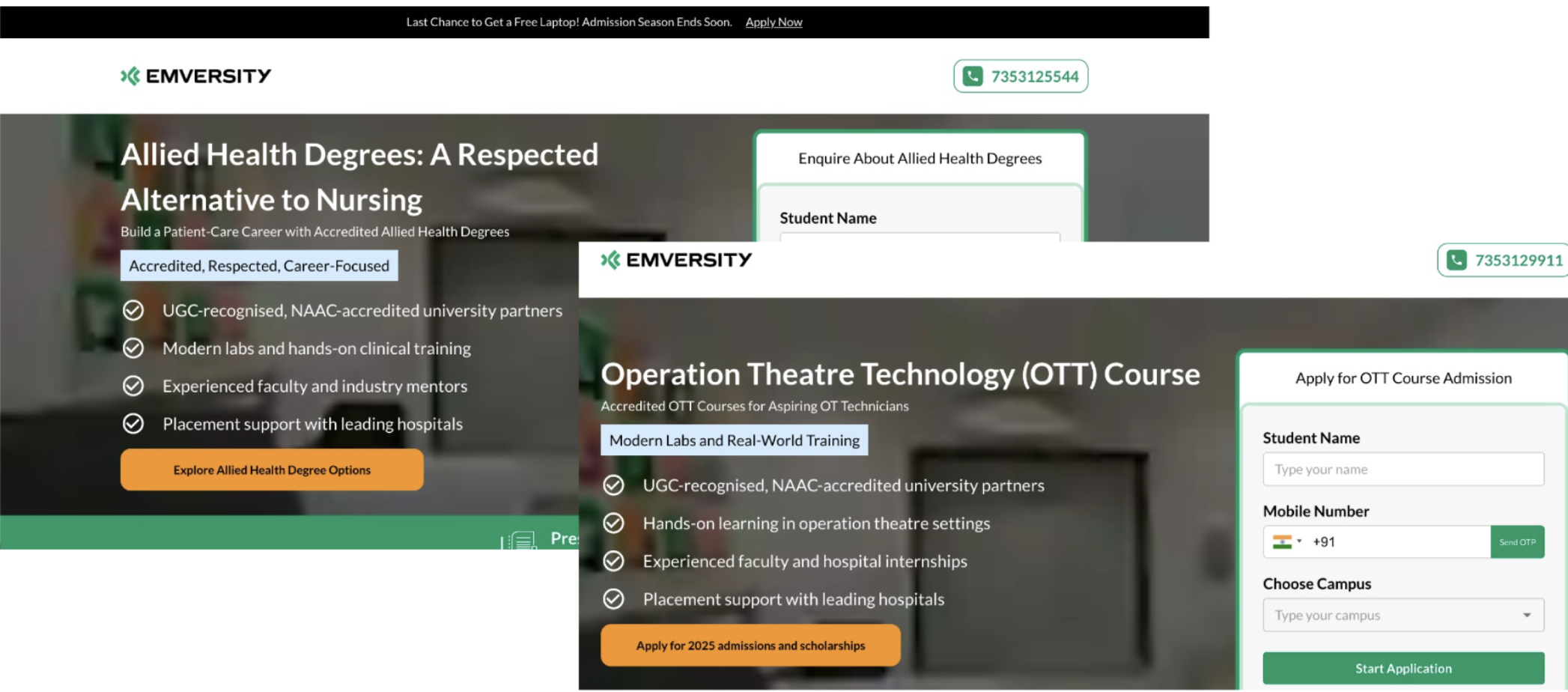
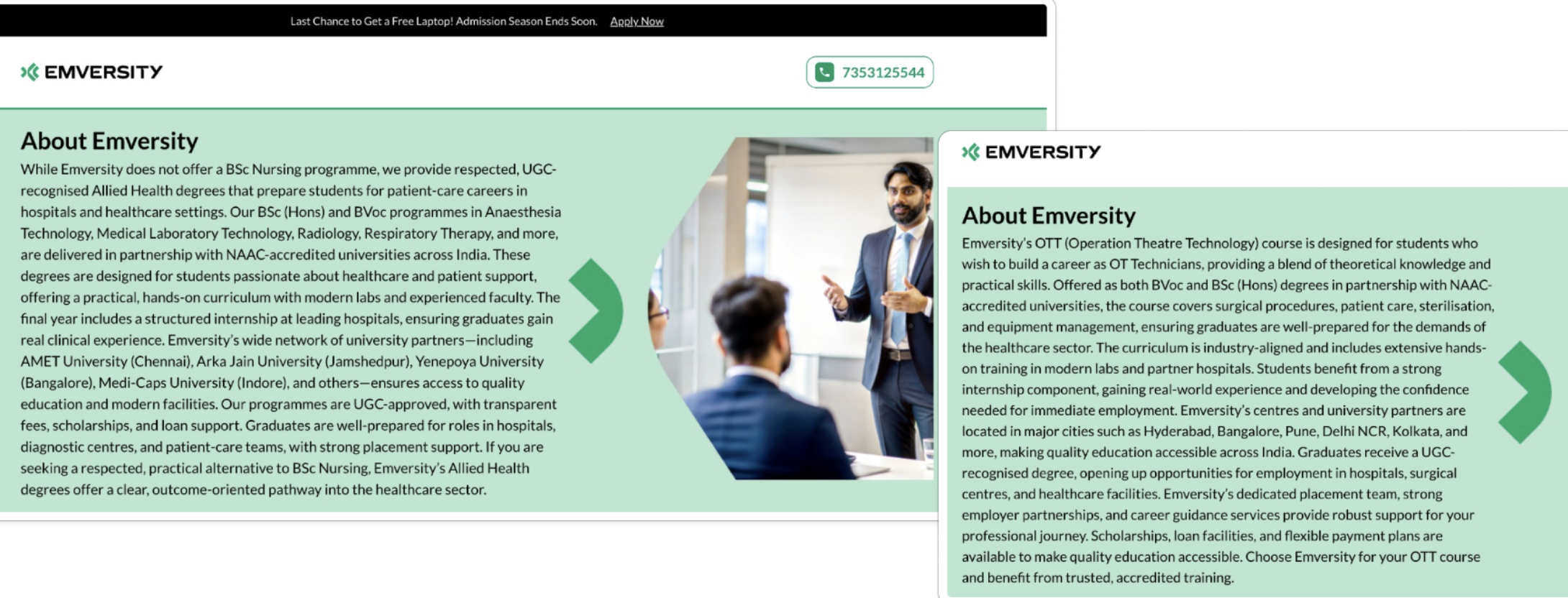
The reframe: this wasn't a marketing optimisation problem — it was a product relevance problem. The landing page was not a surface to tweak. It was an intent mismatch engine that needed to be replaced with a personalisation system.

The Solution
Building intelligence
ECHO was built as a three-layer intent preservation system — starting at acquisition, carried through activation, and handed off to the sales call. Guardrails built in: Semantic deviation rate capped at 0.82 cosine similarity threshold. Fallback to default content JSON when confidence is low, intent is ambiguous, or deviation is high. Graceful degradation at every layer — ECHO never breaks the page.
01
Layer 1 — Acquisition
Reads utm_term at page load. OpenAI rewrites hero headline, subheadline, and CTA in real time. Redis caches variants for sub-300ms delivery. Supports 15,000+ keyword variants.
02
Layer 2 — Activation
Intent-mapped WhatsApp templates sent post lead-capture via Gupshup. Human-in-loop approval. Open rate 55%→81%, reply rate 1%→8%.
03
Layer 3 — Sales Handoff
Intent summary pushed into LeadSquared CRM before first call. Sales agent sees the student's search context. First-call pickup 18%→30%, first-call conversion +112%.
Alternatives Considered
Form optimisation (optimising wrong metric)
Stronger incentives (solving symptoms)
Offer-led funnels (wrong sequencing)
Impact at a glance
Impact
+160%
Visitor → lead conversion
2.1% → 5.5%
+56%
First-call pickup rate
18% → 30%
−52%
Cost per lead
₹946 → ₹445
+112%
First-call conversion
to counselling
↓26pp
Bounce rate
72% → 48%
+137%
D-7 ROAS
from ~3.0 baseline
+2.2pts
Google Ads relevance score
6.1 → 8.3
+91%
D-15 ROAS
sustained improvement
My Role
End-to-end ownership

Sole PM end-to-end. Diagnosed the conversion plateau through behavioural data (Microsoft Clarity, CRM funnel analysis) and first-principles reframing. Personally interviewed 22 bounced users and audited the top 100 paid keywords. Defined ECHO's three-layer architecture and owned the trade-off to scope acquisition first, activation and sales handoff second. Led cross-functional execution with engineering, DevOps, marketing, and sales ops. Owned GenAI guardrails — semantic deviation threshold, fallback logic, and content boundary rules — to ensure ECHO never over-promised or hallucinated.

Key Learnings
What this taught me
01
Relevance over surface optimisation Most landing page conversion problems aren't UI problems — they're relevance problems. Lighthouse scores >85 and perfect CDN optimisation still left us at 2.1% conversion. The page was fast. It just wasn't relevant.
02
Intent is perishable Capturing it at acquisition means nothing if the next touchpoint — WhatsApp message or sales call — resets to generic. ECHO's value compounded because all three layers spoke the same language.
03
Hard guardrails > soft guidelines GenAI in a revenue-critical path requires hard guardrails, not soft guidelines. The semantic deviation threshold wasn't a nice-to-have — it was what made the system safe to run at scale across 15,000+ keyword variants.
04
Quality and volume move together The right metric to optimise for isn't leads — it's intent-qualified leads. Improving conversion from 2.1% to 5.5% while simultaneously improving D-7 ROAS +137% proved that quality and volume moved together when relevance was fixed.